
Jakob Was Half Right
In 2023, Jakob Nielsen argued that AI is introducing the third user-interface paradigm in computing history, a shift he called "intent-based outcome specification." Instead of telling the computer what to do, the user tells it what outcome they want. In short: chat. We think he's right about the direction. We think he's wrong about the destination.
The problem chat creates
When you describe five ideas in five minutes to an AI, you have five open threads. They might conflict. They might overlap. Three of them might be solving the same problem while a more important problem has nothing assigned to it. You can't see any of that in a chat window.
Chat optimises for input speed. It doesn't optimise for coherence. And coherence (knowing how to allocate your time, which ideas are waiting, and which ones you're consciously setting aside) is the actual work of product thinking.
The GUI interaction model was tedious (navigate to the right view, find the right form, fill it in), but that friction had one accidental virtue: it slowed you down enough to impose structure. Remove the friction without replacing the structure and you get faster chaos.
What building a planning tool taught us
We built ProductBrain chat-first. Describe what you're thinking, the AI structures it. Fast, fluid, no forms to fill in.
And then we watched what happened. Ideas poured into the chat and accumulated into trees full of nodes that individually made sense but collectively had no shape. Three approaches under one goal, zero under another that mattered more. Phases full of work with no coherent theme. The chat made input effortless, but it didn't make the thinking visible.
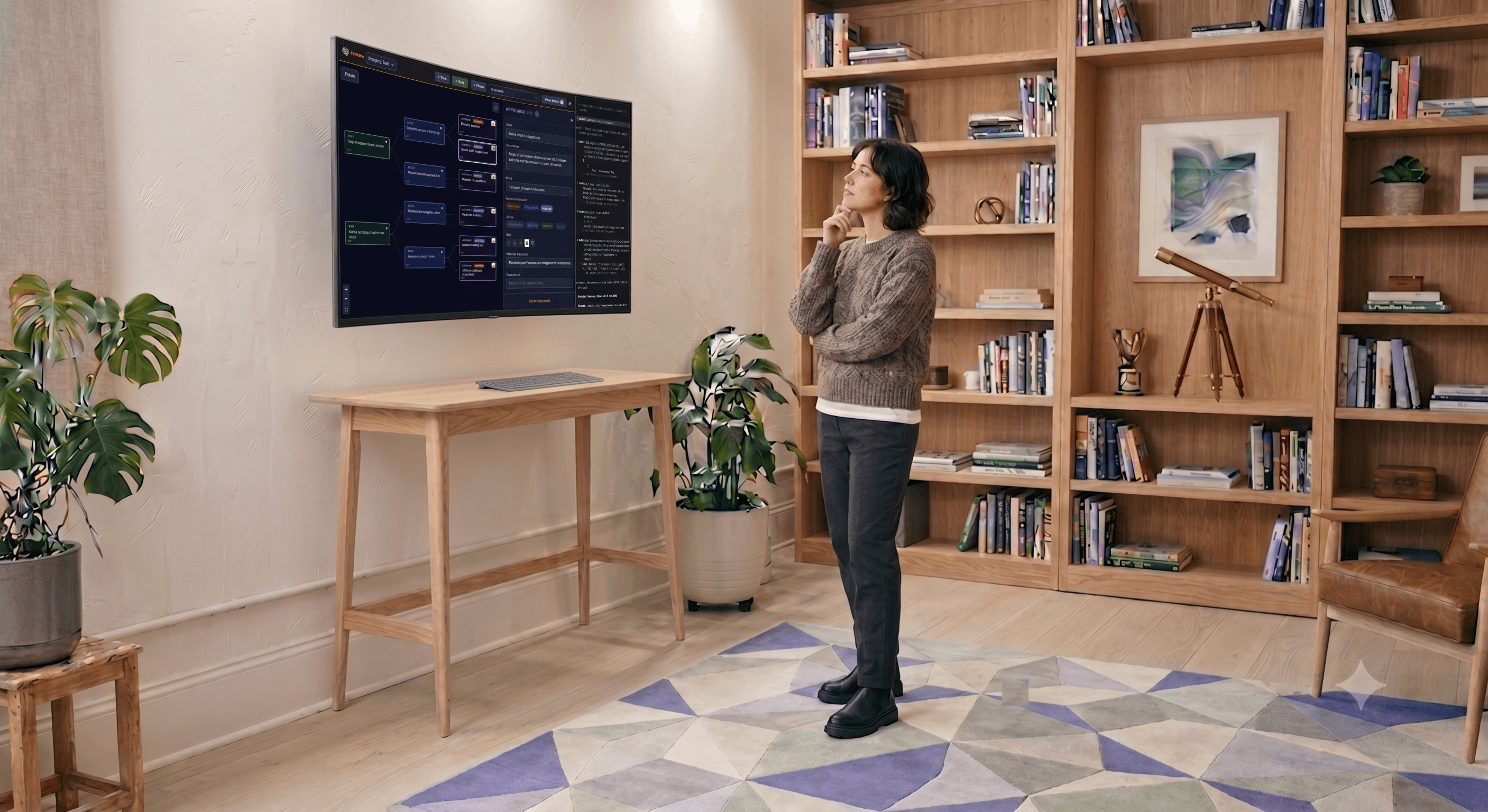
The fix wasn't less chat. It was the canvas that shows you what the chat just produced. A tree that traces every bet back to a business goal. A matrix that shows the delivery shape: what's shipping, what's waiting, what's getting too much attention relative to its importance.
Chat handles input. The structure handles coherence. You need both, and the structure has to update in real time as the chat moves, or the coherence is already stale by the time you look at it.
This is where Nielsen's framing stops short. "User directs the tool" still implies a single interaction stream. The actual shift is toward ambient structure, a canvas that reflects your thinking back at you while you're still thinking, not after you've finished.
The GUI is younger than it feels
When Steve Jobs confronted Bill Gates about Windows copying the Mac, Gates didn't deny it. He reframed it. The exchange has been recalled by people who were in the room: "Well, Steve, I think it's more like we both had this rich neighbor named Xerox and I broke into his house to steal the TV set and found out that you had already stolen it."
What Jobs saw at Xerox PARC in 1979, and what both men spent the next decade building empires on, was a specific interaction paradigm. Not just a visual interface, but a metaphor: the desktop. Trash cans, file folders, scroll bars, window panes. Physical-world objects rendered digitally so that people who had never touched a computer could understand what they were doing. Point at the thing. Click the thing. Drag the thing to the bin.
It was a brilliant solution to a specific problem: how do you make a computer legible to a general population with no prior reference point? The physical metaphor was the onramp. It worked so well, and for so long, that we stopped seeing it as a design decision. It became the definition of what a computer looked like.
The keyboard predates all of this. It ran through the typewriter era, survived the GUI, and Nielsen's argument is that it will outlast it too. What's actually young (no more than fifty years old, built on an insight that Jobs had in a Californian research lab) is the paradigm underneath it. The mouse. The window. The trash can. The idea that interacting with a computer means pointing at visual representations of physical objects.
That's the foundation that's crumbling. It isn't crumbling because it was wrong. It was always a temporary solution to a temporary problem. The general population now has a different language for digital systems. They don't need the trash can to understand deletion. They don't need the folder to understand organisation. The metaphor did its job. The job is done.
The Don Draper desk
Could you imagine Don Draper sitting behind a screen, navigating menus, filling out forms, updating a project tracker? The image is absurd, and the reason isn't that he's too important for admin. His job was thinking. Reading people. Making judgment calls in real time. Anything that put friction between him and that work would have made him worse at it, not more organised.
When one of our team attended a UX workshop years ago, the fun task for the evening was to design a workstation for a knowledge worker. Most participants filled the desk with screens, keyboards, peripherals. The desk that came back from our corner had almost nothing on it: a phone, a few objects, a place to write longhand.
People laughed. But that was the point. The tool should serve the thinking, not the other way around.
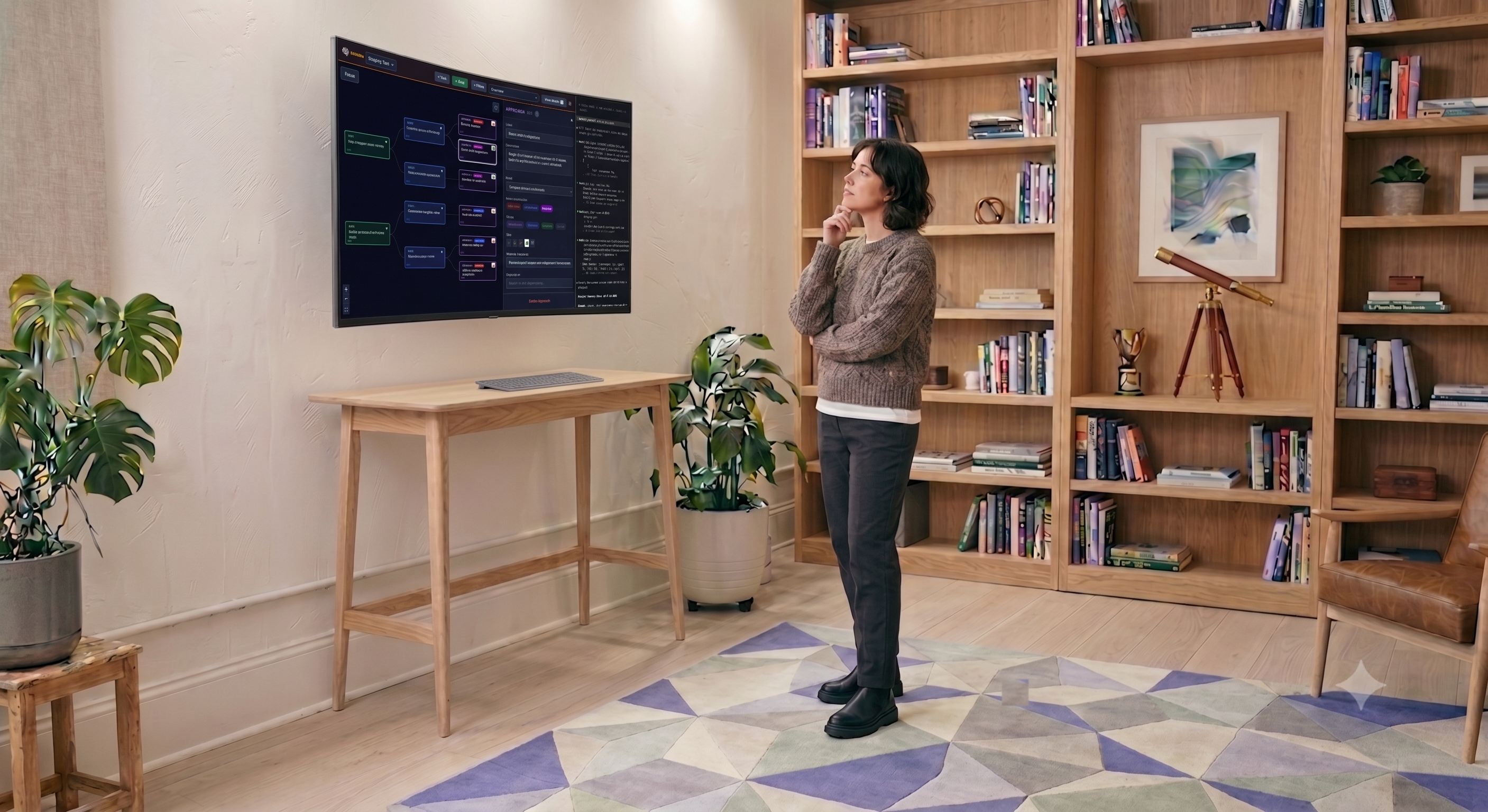
The setup that was always possible, and is genuinely available now, is a screen on the wall and a voice interface. Not holographic displays, not spatial computing. A monitor and a microphone. You talk, or you type, the structure updates, the canvas stays visible. The pointing and clicking disappears. The thinking stays central.
This is what the Minority Report image was actually showing, under the gesture theatre. Not the hand-waving, the screen. A large, always-visible canvas that lets you do two things: see the relationships between everything at once, and drill into any part of it. That's the complete interaction model. The GUI buried both under layers of navigation and metaphor. An intent-driven canvas with ambient structure doesn't need the layers. You see the whole. You ask for the detail. The structure stays live while you think.
What this means for product tools
Most product tools were designed for the GUI era. They assumed you'd sit down, open the app, navigate through a hierarchy of menus and panes, and manipulate objects with a cursor. The interaction model inherited the desktop metaphor wholesale, because that's what users knew, and building against it meant teaching people a new language before they could do any work.
Intent-first doesn't just change the input method. It changes what the tool has to do. A tool designed for pointing and clicking can afford to be passive: present the objects, wait for the user to manipulate them. A tool designed around intent has to be active. It has to maintain the structure while you think out loud (or type it out, whichever way your thinking flows), surface the contradictions you haven't noticed, and show you the shape of your thinking in real time.
That's a harder problem. It's also the right problem. The knowledge worker's job was never object manipulation. It was judgment: deciding what matters, what to do next, and what to let go. The GUI gave us a way to do that work, but it also imposed its own overhead: navigate to the right view, find the right object, perform the right action. Every interaction mediated by the metaphor.
Nielsen saw the input shift clearly. What he underweights is the structural shift from tools that store what you've decided to tools that help you decide. That's not a feature improvement on the existing paradigm. It's the next one.
The destination
The move isn't from "operates" to "directs." It's from "operates" to "amplifies and makes visible."
The GUI made you operate the machine through a layer of physical metaphor. Intent-based tools let you direct it. But the real shift is what happens to your thinking in the process: AI accelerates and retrieves, handling the fact-finding and the structuring work that used to require manual effort. The canvas (and let's not call it a UI, because that carries too much of the old paradigm with it) makes the output of that thinking visible as structure you can navigate. See the relationships. Go deep on any part. Watch it update as your thinking moves.
That's the destination. Chat is one input mechanism toward it. The keyboard is another. What changes isn't how you type: it's what appears on the other side.
The screen stays. The trash can goes in the trash.
Reference: How AI Changes the Way We Use Computers, Jakob Nielsen, NNGroup