
The Fifth Door Is Still Work
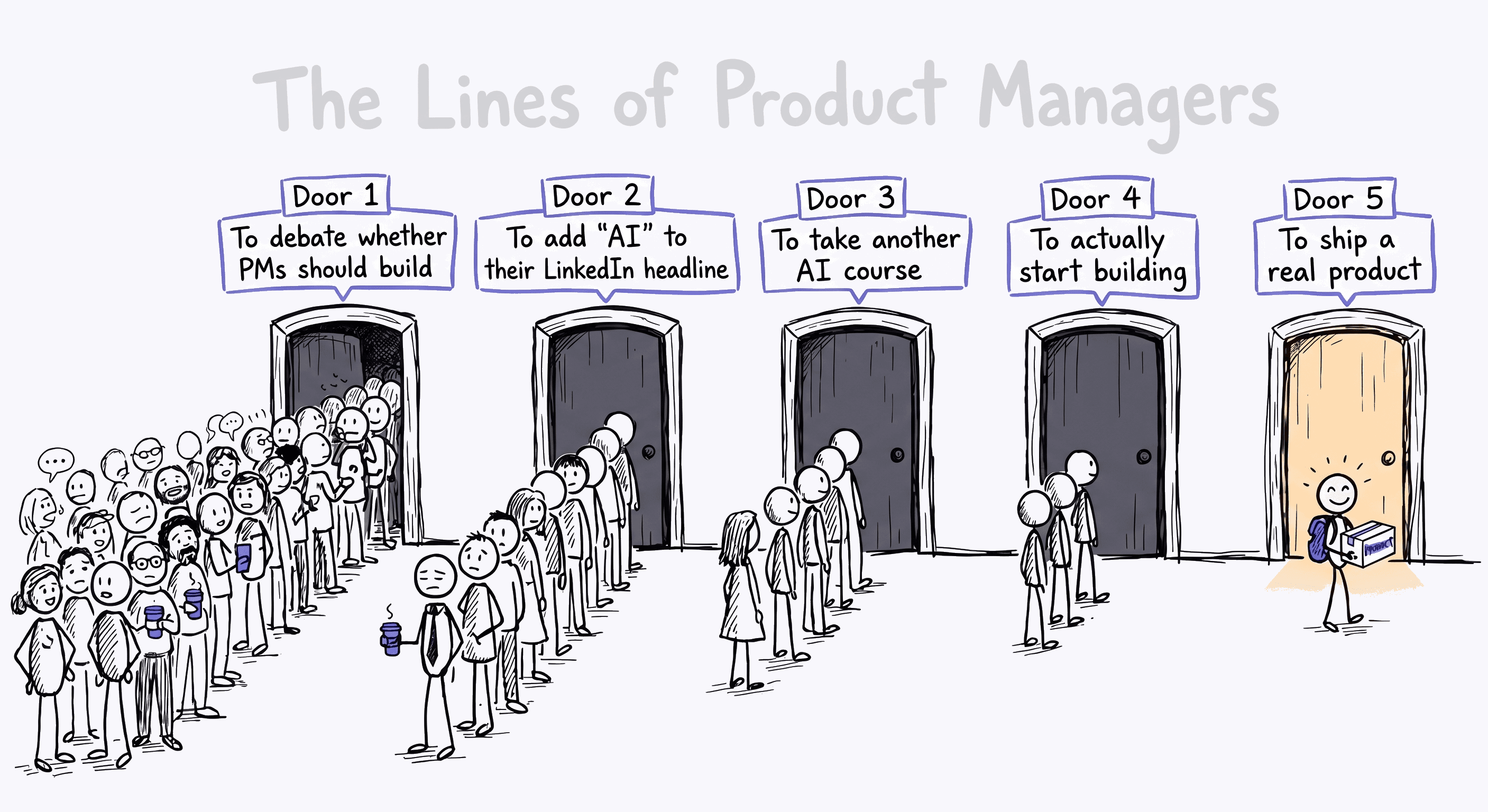
A cartoon has been doing the rounds. Five doors. Most product managers are queued at the first three, debating AI, updating their LinkedIn headline, taking a course. A few are at door four, starting to build. Almost nobody is at door five: shipping a real product.
The post got fifty-odd comments. The most interesting one wasn't about the cartoon at all. It was this: building is cheap now. The short line isn't door five: it's knowing which problem is worth solving and whether anyone will pay for the answer.
That comment is right. It's also the point. Vibe coding moved the bottleneck. It didn't remove it.
Floor one is fast
You can go from idea to working prototype in an afternoon. This is real. The agent writes the component, the page loads, the feature works. For anyone who spent years waiting on engineering capacity, the feeling is genuinely disorienting. The thing you described is just there.
But what's there is a demo. It runs on your machine, for one user, with no authentication, no deployment pipeline, no security boundaries, and no way for anyone to find it. The demo is valuable: it proves the concept, builds conviction, lets you test whether the idea has legs. The distance between a demo and a product is where most vibe-coded projects quietly stop.
Not because the code was bad. Because nobody planned for the other five levels.
The building behind the door
Architecture is the first floor most people skip. The agent is brilliant at the task and blind to the system. It builds exactly what you ask for, optimised locally, without considering how it connects to everything else. You get a feature that works in isolation and breaks three things downstream. Somebody needs to hold the system in their head. Not necessarily build it, but know enough to ask where this new thing touches everything that already exists.
DevOps is the gate between your machine and the world. CI/CD, staging environments, rollback plans, environment scoping. The agent writes the feature. You own the pipeline that protects your users from your velocity. This is unglamorous work that becomes catastrophic when it's missing.
Security is the floor nobody thinks about until they have to. Row-level security, auth boundaries, API key scoping, rate limiting. The agent doesn't think about who's watching. It will expose a service role key if you let it. Security is the stuff that never appears in the changelog but defines what kind of company you are.
SEO and discoverability is where good products disappear. Meta descriptions, structured data, sitemaps, the llms-full.txt that tells language models how to index you. You can build the best product in the world and it doesn't matter if nobody can find it. The agent can't solve this for you. It builds the product, not the surface area the world uses to discover it.
Content is the twenty percent human pass that makes everything credible. Release notes, documentation, the changelog that builds trust over time. The agent drafts fast. The voice that makes it feel like a real company is still yours.
Product thinking is the floor that was always yours. The agent ships what you tell it, not what you should build. Opportunity cost, bet visibility, the thread that connects every piece of work back to a business goal. AI accelerates execution. It doesn't resolve the decisions upstream of execution.
The thing the agent won't tell you
One observation from the comments cuts through: AI doesn't flag its own mistakes. A developer with fluency spots the architectural problem the agent introduced on floor three. A PM without that fluency ships it, and finds out six months later when something breaks in production in a way that's hard to trace.
This is the real argument for PMs building: you can't apply discernment to a floor you've never stood on. Getting your hands dirty is the only way to learn.
You don't need deep expertise in each discipline. You need enough familiarity to know when the agent's answer is good enough and when it's confidently wrong.
That's a different skill than coding. It's closer to the skill PMs have always needed: reading output, asking the right questions, knowing where to go deeper. The surface area just got wider.
The bottleneck moved
The comment about the short line is worth sitting with. If building is cheap, the competitive edge isn't who can build fastest. It's who decides best: which problem is worth the building, which solution is worth shipping, which of the six floors needs more attention than the agent gave it.
That's not a new skill for product people. It's the original skill, applied to a new context. The PM who was good at prioritisation before AI is still good at it. The difference is that now the prioritisation surface includes architecture decisions, deployment choices, and security boundaries that used to belong to someone else.
The fifth door is open. What it doesn't show is that walking through it means taking ownership of the whole building, not just the floor the agent handed you.
This isn't for everyone. But the individuals and small teams who take it on seriously, who treat each level as real work, not an afterthought, are the ones who will actually ship.